Choosing Gypsum for Concrete
What type of gypsum is suitable for plastering on concrete? In this article, learn about the factors affecting gypsum adhesion to concrete, the concrete surface preparation method when using primer before gypsum application, and important tips for selecting the right gypsum.
Why Choosing Gypsum for Concrete Matters
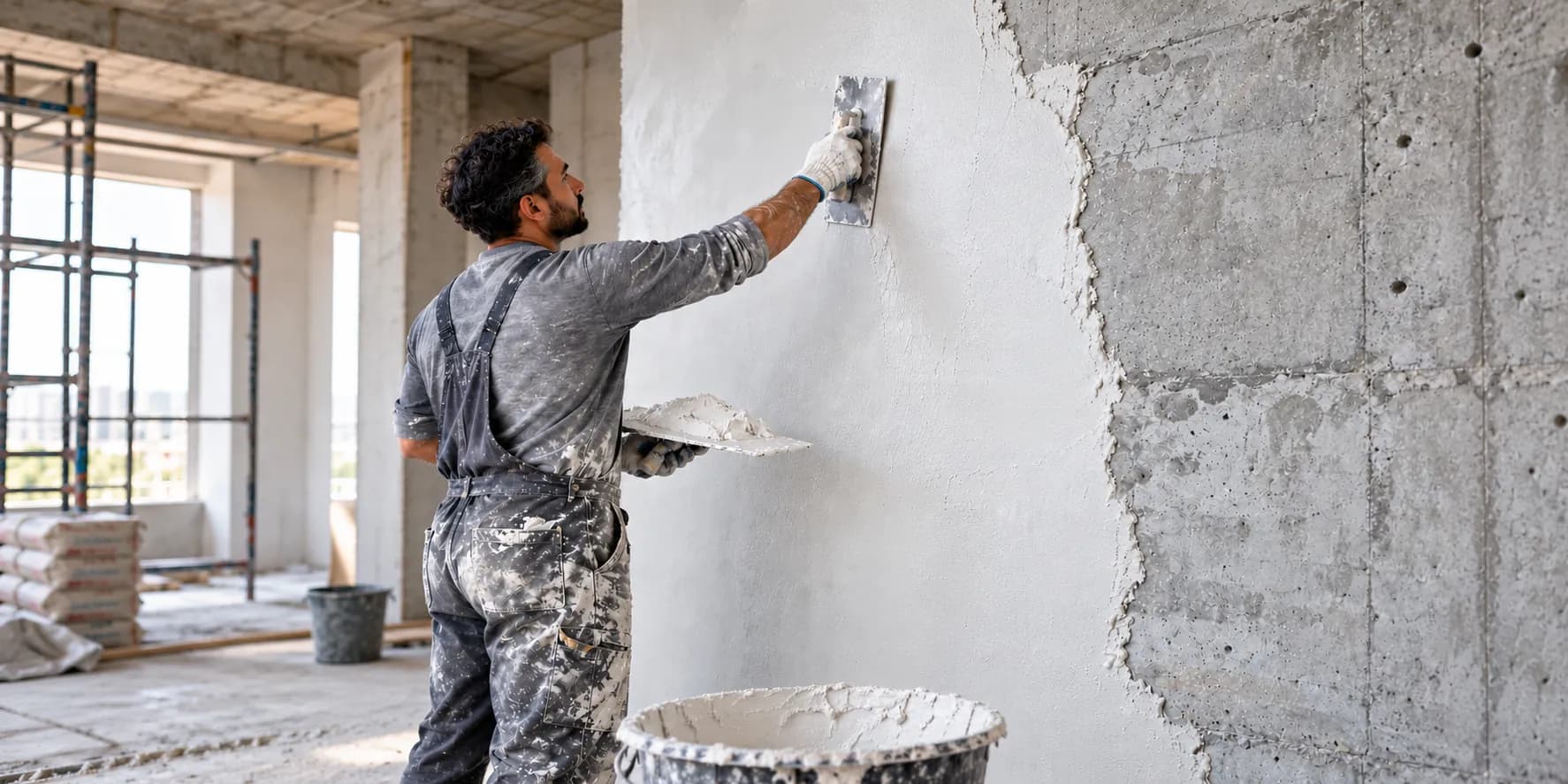
Plastering on concrete is one of the critical stages of thin-coat finishing in construction that, due to the specific characteristics of concrete surfaces, requires greater precision compared to some other substrates. Concrete, due to its relatively high density, variable water absorption, and sometimes smooth and dense surface, may not create suitable conditions for direct gypsum adhesion. For this reason, selecting the right gypsum for concrete depends not only on the quality of the gypsum powder but also on the condition of the concrete surface, water absorption rate, preparation method, and gypsum application conditions.
If gypsum is selected and applied without considering the characteristics of the concrete surface, the likelihood of problems such as reduced adhesion, delamination of the gypsum layer from concrete, cracking, and localized voids increases. These problems, in addition to reducing the visual quality of the wall or ceiling, can also increase repair and re-application costs.
On the other hand, the principled selection of a suitable basecoat or polymer-modified gypsum, along with proper surface preparation, can help improve adhesion and increase the durability of the gypsum coating.
In this article, we examine what type of gypsum is suitable for plastering on concrete, what factors influence gypsum selection, and how to prevent common problems when applying gypsum on concrete surfaces.
Why Is Plastering on Concrete Different from Plastering on Brick?
One of the most important points in selecting gypsum for concrete is attention to the difference between concrete surface characteristics and materials such as brick and masonry blocks.
Brick surfaces and many masonry substrates, due to the presence of pores and surface texture characteristics, can provide different conditions for water absorption and mechanical interlocking of the gypsum mortar. In contrast, concrete surfaces, especially cast-in-place concrete with a smooth finish, may be dense and low-absorption.
This difference affects the gypsum application method and its adhesion level.
The most important concrete characteristics to consider when selecting gypsum include:
* Surface water absorption: Dense concrete typically has lower water absorption than many masonry substrates; however, concrete's water absorption depends on mix design, compaction, surface finishing, and environmental conditions.
* Surface roughness: A rough surface with suitable texture can improve mechanical interlocking of the coating, while a very smooth surface may require special preparation.
* Presence of form release agents: Residual form oil or similar contaminants on concrete can severely reduce gypsum coating adhesion.
* Concrete density and quality: Dense concrete, porous concrete, and concrete with weak or scaled surfaces do not provide uniform conditions for gypsum application.
* Moisture and environmental conditions: Substrate moisture, ambient temperature, and drying conditions can affect the performance of the gypsum layer.
Therefore, one cannot confirm a product's suitability for all concrete surfaces based solely on the name of the concrete or type of gypsum. Correct selection must be based on actual surface conditions and product technical specifications.
What Type of Gypsum Is Suitable for Plastering on Concrete?
To select the right gypsum for concrete, it must first be determined whether the goal is applying a basecoat gypsum layer, leveling the surface, or creating a smooth finish coat. It must also be clear whether the intended product is designed for application on concrete.
Generally, three product groups can be examined for this application:
a) Building Gypsums with Approval for Concrete Application
Some conventional building gypsums are also designed for application on concrete surfaces. However, the usability of these products on concrete depends on their technical specifications and surface conditions.
On smooth, low-absorption concretes, using a suitable building gypsum alone may not be sufficient, and applying a bonding layer before plastering may be necessary.
Therefore, when purchasing gypsum for concrete, it is better to check the product's technical specifications and ask the manufacturer about its applicability on concrete, permitted thickness, and required preparation type.
b) Polymer-Modified Gypsums Designed for Concrete Application
Polymer-modified gypsums, due to the use of modifying additives in their formulation, can be designed to improve certain mortar properties, including adhesion and workability.
However, being polymer-modified alone does not guarantee suitable adhesion to concrete. Final performance depends on the type and amount of additives, product formulation, concrete quality, and its application guidelines.
If you intend to use polymer-modified gypsum on a concrete wall or ceiling, select a product whose manufacturer has approved its application for this substrate type.
Also note that not all polymer-modified gypsums are produced for the same conditions. Some products are designed for machine application and some for hand application. Selection among these products should be based on the application method and project conditions.
c) Gypsums for Single-Coat Application
Some gypsum products are produced with the aim of direct application and creating a relatively smooth finish surface in a single stage. If approved by the manufacturer, these products can be suitable for plastering on concrete in building interiors.
For example, Knauf, in introducing one of its gypsum products, lists concrete and cementitious surfaces among usable substrates and recommends using a special gypsum bonding agent on concrete for better performance. This example shows that selecting the right gypsum and substrate preparation must be considered as a package; because even a concrete-suitable product may require special preparation.
Important Note: None of these three groups can be considered the best option for all concrete surfaces without checking technical specifications. The main criterion is product compatibility with the substrate and actual application conditions.
The Role of Concrete Adhesive and Primer in Plastering on Concrete
One of the most critical factors in successful plastering on concrete is selecting the appropriate method for creating a bond between the concrete surface and the gypsum layer.
At this stage, the difference between concrete adhesive and gypsum-specific bonding primer must be noted. These products are not identical in terms of formulation, application, and consumption method.
A gypsum-specific bonding primer is a product designed to improve gypsum adhesion to smooth, low-absorption substrates such as certain concrete surfaces. Some of these primers contain granular particles that, after drying, create a surface with more suitable texture for gypsum layer adhesion.
For example, MultiGips Betonkontakt is introduced as a bonding agent for gypsum application on dense, smooth, and low-absorption surfaces. Also, DCP offers Grundix BetonContact to improve the adhesion of machine-applied gypsums to smooth, low-absorption concrete.
On the other hand, the term "concrete adhesive" may refer to various products, some of which are designed for cementitious applications or special mortars. Therefore, not every type of concrete adhesive can substitute a gypsum-specific primer.
For correct selection, pay attention to the following:
* The product must be suitable for bonding gypsum to concrete or the intended substrate.
* The manufacturer's instructions regarding application method and drying time must be followed.
* The surface must be cleaned of dust, grease, and form release agents before primer application.
* Gypsum application must be performed within the time recommended by the primer manufacturer.
* Avoid diluting or mixing the primer with other materials without manufacturer approval.
Using an unsuitable primer or applying gypsum before the bonding layer is ready may not produce the desired result. Consequently, the product type and adherence to its application instructions are as important as gypsum quality.
Concrete Surface Preparation Before Plastering
Even high-quality gypsum will not perform satisfactorily on a contaminated, weak, or unsuitable surface. Therefore, concrete preparation is one of the fundamental stages before gypsum application.
Concrete Surface Cleaning:
First, dust, grease, form oil residues, loose particles, and any material preventing adhesion must be removed from the concrete surface.
The presence of form oil is of particular importance; because these materials can act as a separating layer between concrete and gypsum and prevent proper bond formation.
Surface Strength Inspection:
The concrete surface must be inspected for strength and presence of scaled layers. If the surface is weak, powdery, or has delaminating sections, the cause must first be identified and unsuitable parts repaired according to appropriate application methods.
Applying gypsum on weak concrete without addressing the substrate problem can lead to gypsum layer delamination.
Roughness and Water Absorption Assessment:
The concrete surface must be evaluated in terms of smoothness level and water absorption. Smooth, dense concretes usually require more attention regarding bond creation.
If the surface is excessively smooth, a suitable adhesion enhancement method must be used according to the plastering system guidelines. This method may include a concrete-specific bonding primer or approved mechanical preparation.
Attention to Concrete Moisture
Substrate moisture level is also important in selecting the plastering system. Fresh or damp concrete may not be suitable for some gypsum products.
For example, the MultiGips plastering system specifies a specific condition for residual concrete moisture when using gypsum on interior concrete. The permitted moisture level and measurement method must be determined according to the selected product specifications. Therefore, before gypsum application, ensure the concrete's moisture conditions are suitable.
5. Difference in Gypsum Selection for Concrete Walls vs. Concrete Ceilings
One of the points to consider when selecting gypsum for concrete is the application location. Although concrete walls and ceilings may have similar substrate characteristics in terms of material, gypsum application conditions on them are not identical.
a) Gypsum Selection for Concrete Walls
In concrete wall plastering, surface unevenness level, required thickness, and adhesion conditions are determining factors.
If the concrete wall is smooth and low-absorption, using concrete-compatible gypsum along with a suitable bonding primer can help create better adhesion.
In walls with significant unevenness, the appropriate leveling method and permitted gypsum layer thickness must first be determined. Increasing gypsum thickness without considering product specifications and its adhesion capacity can increase the risk of cracking or delamination.
b) Gypsum Selection for Concrete Ceilings
Concrete ceiling plastering, due to the mortar being placed on the underside, has higher sensitivity regarding adhesion and correct application.
In these conditions, selecting a product approved for concrete ceiling application is of great importance. Also, surface preparation, use of suitable primer, and adherence to permitted thickness must be performed with precision.
On precast concrete ceilings or surfaces cast with smooth forms, due to surface density and smoothness, the use of a suitable bonding system may be essential.
Application Note:
For concrete ceiling plastering, do not rely solely on phrases like "polymer-modified gypsum" or "high-adhesion gypsum" on the packaging. Product suitability for ceilings, concrete type, and intended application thickness must be confirmed through its technical specifications.
6. What Factors Cause Gypsum Delamination from Concrete?
Gypsum delamination from concrete is a problem that can occur with incorrect product selection or non-principled application.
The most influential factors on this problem include:
Therefore, to prevent gypsum delamination from concrete, gypsum powder quality, substrate condition, and application stages must be integrally examined.
7. What to Consider When Buying Suitable Gypsum for Concrete?
For selecting suitable gypsum for concrete, it is better not to base your purchase decision solely on product price or whiteness level. Technical specifications and product applicability in project conditions are more important.
The following can help with better selection:
* Concrete application capability: Verify that the manufacturer has approved product application on concrete.
* Application type: Determine whether gypsum is needed for basecoat, finish coat, or single-coat application.
* Application method: The product must be compatible with the project's hand or machine application method.
* Adhesion: Check technical specifications and information related to product performance on the intended substrate.
* Setting time: Setting time must be compatible with the application method, environmental conditions, and application crew speed.
* Permitted thickness: Check the executable thickness range from the product instructions.
* Primer requirement: Determine whether gypsum application requires a bonding primer.
* Product quality and consistency: Production quality, packaging conditions, and gypsum storage also matter in its performance.
In large projects, it is better to apply a limited section of the surface as a sample before extensive application. This allows checking material compatibility, application quality, and adhesion conditions.
8. Is Conventional Gypsum Suitable for Concrete or Polymer-Modified Gypsum?
This question does not have a single answer for all projects. Conventional gypsum, if suitable for the intended concrete substrate and surface preparation is performed according to instructions, can be a viable option.
Conversely, polymer-modified gypsum, if designed for concrete application, may be a suitable choice due to its formulation characteristics.
Gypton gypsum is designed for concrete surfaces and typically requires surface preparation and a suitable primer for increased adhesion; however, Sahar Semnan Gypsum with direct application capability on concrete, without the need for a primer or separate additive, eliminates surface preparation stages and helps reduce cost and increase application speed.
Conclusion: What Is the Best Gypsum for Concrete?
Gypsum selection for concrete depends on a set of technical factors, and one gypsum type cannot be introduced as the best option for all concrete surfaces without examining project conditions.
To achieve the desired result, the concrete surface condition must first be examined in terms of smoothness, water absorption, strength, contamination, and moisture. Then, a gypsum should be selected whose manufacturer has approved its use for concrete.
On many smooth, low-absorption concrete surfaces, using a gypsum-specific bonding primer can play an important role in improving adhesion. Of course, the primer type and its application method must be compatible with the selected plastering system.
However, as mentioned earlier, Gypton gypsum is suitable for concrete surfaces. But in recent years, Sahar Semnan Gypsum Factory has produced a type of Gypton gypsum that does not require a primer and no special additive has been used in its formulation.
Ultimately, gypsum quality, principled concrete preparation when using primer, and adherence to application instructions are three key factors in increasing gypsum plastering durability on concrete. Attention to these points can reduce the probability of problems such as cracking and delamination and help achieve a smooth, uniform, and durable surface.
Technical References for Further Study
FAQ
انتخاب گچ برای بتن چیست؟
برای گچکاری روی بتن چه نوع گچی مناسب است؟ در این مقاله با عوامل مؤثر بر چسبندگی گچ به بتن، روش آمادهسازی سطح بتنی در صورت استفاده از پرایمر قبل از بتن و نکات مهم انتخاب گچ مناسب آشنا شوید.
برای انتخاب انتخاب گچ برای بتن به چه نکاتی توجه کنیم؟
چرا انتخاب گچ برای بتن اهمیت دارد؟