The Effect of Gypsum Grain Size on the Quality of Construction Gypsum: From Adhesion to Strength and Setting Time
In this article, we examine the role of particle size and grain distribution in strength, setting time, water consumption, workability, and the final quality of gypsum.
Introduction:
The quality of construction gypsum is not solely dependent on the purity of the gypsum stone, firing conditions, or type of mineral. The physical properties of gypsum powder, particularly grain size and particle size distribution, play a significant role in the behavior of gypsum when mixed with water, setting time, and the strength of the hardened product.
Two gypsum samples may have very similar chemical compositions, but due to differences in particle size and how they are distributed, they may not perform equally during application. For example, one gypsum may require more water to reach the appropriate concentration, while another achieves good workability with a lower water-to-gypsum ratio.
These differences are very important for plasterers, construction contractors, and gypsum manufacturers; because they affect the speed of application, ease of spreading the mortar, surface finishing, and the final quality of plastering.
On the other hand, increasing the fineness of gypsum does not always mean increasing its quality. The final result depends on a set of factors, including particle size distribution, types of calcium sulfate phases, firing conditions, additives, and the water-to-gypsum ratio.
In this article, we examine the effect of gypsum grain size on the quality of construction gypsum from a technical perspective and explain why controlling particle size is important in the gypsum production process.
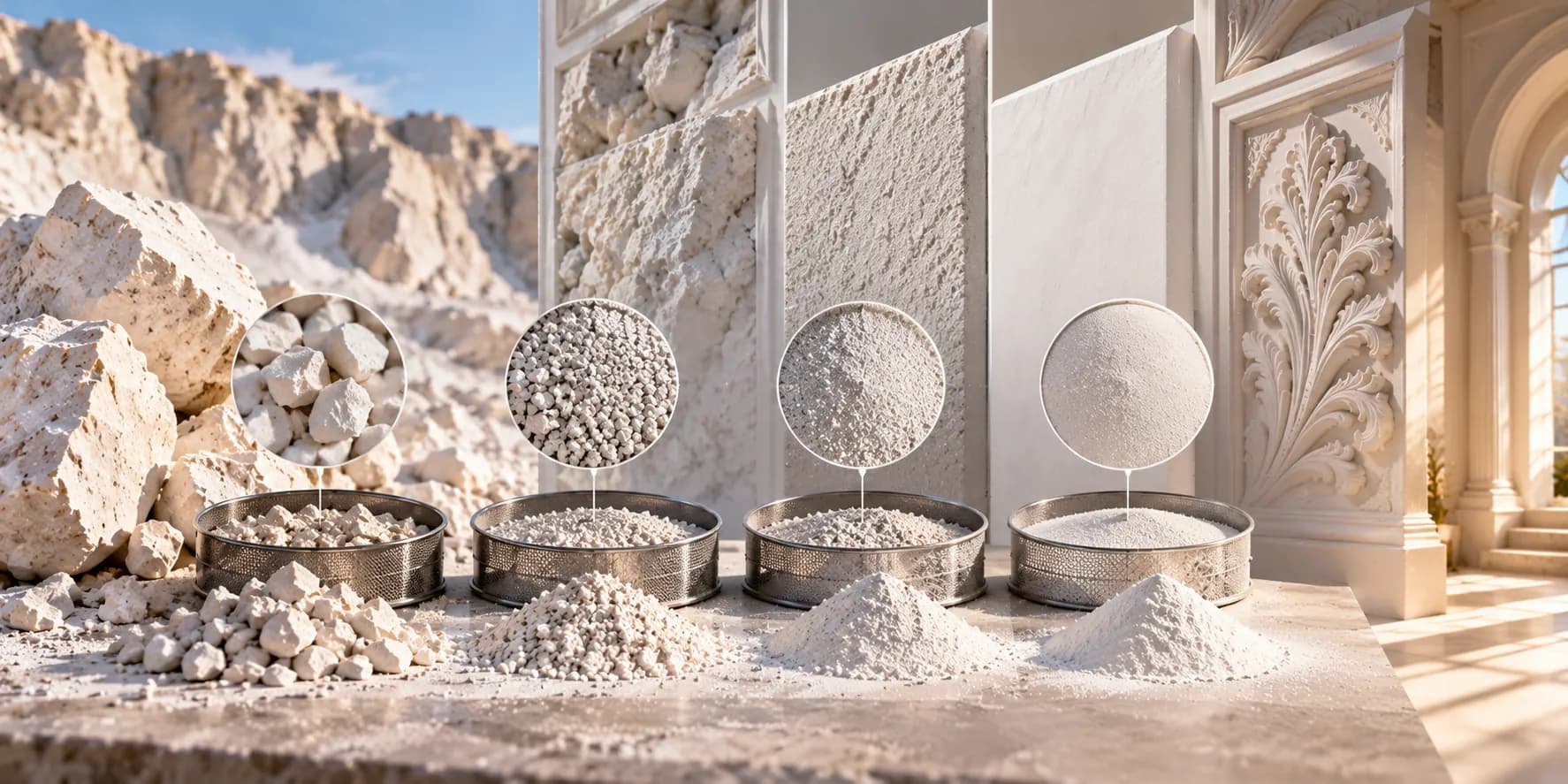
Gypsum grain size refers to the distribution of particle sizes that make up the gypsum powder. This characteristic determines what proportion of the product particles fall within various size ranges.
In the production process of construction gypsum, the gypsum stone after extraction and preparation undergoes heat treatment, and then the resulting product is ground according to the required characteristics. At this stage, the final particle size is influenced by the type of grinder, equipment operating conditions, and material properties.
To evaluate gypsum grain size, methods such as sieving and particle size analysis are used. In the sieving method, the gypsum powder is passed through a series of sieves with specific mesh sizes, and the amount remaining on each sieve is measured.
The results of this test help determine how much of the gypsum powder consists of coarser particles and what proportion is made up of finer particles.
Two important concepts in grain size analysis are:
a) Particle size: indicates the dimensions of individual powder particles.
b) Particle size distribution: shows what proportion of particles exist in different sizes.
These two concepts are not the same. Two products may have similar average particle sizes, but different particle size distributions. This difference can affect how particles are arranged next to each other, water demand, and mortar characteristics.
A study published in the journal Powder Technology also showed that particle size and the breadth of its distribution can affect the water-to-gypsum ratio, hydration rate, and compressive strength of hardened gypsum.
One of the most important effects of gypsum grain size is the amount of water needed to achieve the appropriate consistency of the mortar.
When gypsum powder is mixed with water, the particles must be properly dispersed in water, and the process of dissolving and recrystallizing calcium sulfate must occur. Particle size and surface characteristics can affect the behavior of this mixture.
Generally, reducing particle size can increase the specific surface area of the powder; that is, the available surface area of particles per unit mass increases. However, increasing specific surface area alone does not determine water consumption, and particle shape, surface characteristics, and how they aggregate are also important.
In some cases, finer gypsum may require more water to achieve the same consistency. In a study on alpha calcium sulfate hemihydrate, changing the characteristic particle size from about 19.8 to 53.9 micrometers reduced the water-to-hemihydrate ratio required for standard consistency from about 0.37 to 0.30. This result applies to those specific samples and test conditions and should not be generalized to all construction gypsums.
Why is water consumption important?
Water in gypsum mortar has two main roles
* Providing the necessary conditions for mixing and applying the mortar.
* Participating in the hydration reaction and converting hemihydrate to dihydrate of calcium sulfate.
Water that exceeds the amount consumed in the chemical reaction and required for creating the hydrated structure may exit the structure upon drying and leave pores in the hardened product.
Therefore, excessive water addition to compensate for poor workability can lead to reduced density and mechanical strength of the hardened gypsum.
It should be noted that gypsum water consumption is not only dependent on grain size, and chemical composition, type of hemihydrate, additives, and mixing method also affect it.
The setting time of gypsum is one of the most important quality indicators of its performance in construction. This property determines how long the mortar has for application and finishing after being mixed with water, and when it reaches the initial and final setting stages.
After mixing gypsum with water, calcium sulfate hemihydrate dissolves and calcium sulfate dihydrate forms. As dihydrate crystals grow and bond together, the solid structure of gypsum is formed.
Particle size can affect the speed of this process; because finer particles, under the same conditions, may dissolve faster and influence the crystal formation process.
In studies related to alpha calcium sulfate hemihydrate, reducing particle size under specific conditions has been associated with increased hydration rate. However, the effect of grain size on setting time also depends on the product composition and test conditions.
From the perspective of production and application, controlling setting time is very important:
* Very fast setting: may not leave enough time for mixing, transporting, spreading, and finishing the mortar.
* Too long setting: can reduce the speed of construction operations.
* Controlled setting: allows proper application and high-quality finishing.
An important point is that setting time cannot be adjusted only by increasing or decreasing gypsum fineness. Firing conditions, calcium sulfate phases, impurities, setting time adjusting additives, water temperature, and mixing conditions also play a role in this property.
Therefore, in a gypsum production plant, grain size control should be done alongside setting time tests and other quality control tests.
The compressive strength of hardened gypsum is one of the important indicators for evaluating its mechanical performance. This property refers to the ability of the sample to withstand compressive loads before failure.
Gypsum grain size can affect the final strength through several pathways.
First, proper particle size distribution may affect how particles are arranged in the gypsum paste and the structure formed by crystallization. Second, particle size can change water demand and hydration rate. These changes also affect the porosity and crystal network structure of the hardened gypsum.
In a study on the particle size distribution of alpha hemihydrate, it was found that different parts of particle sizes can have different effects on compressive strength. In other words, the relationship between grain size and strength is not merely about how fine the gypsum powder is; the proportion of each size group is also important.
On the other hand, the amount of water used plays an important role in the final strength. If too much water is added to the mortar to achieve appropriate workability, more pores may remain in the structure after drying, and strength may decrease.
For this reason, in evaluating gypsum quality, the following factors should be considered:
* Technical note: Finer gypsum does not necessarily have higher compressive strength. For valid comparison, samples should be tested under the same method and conditions.
Micronized gypsum refers to gypsum that has been produced with the aim of achieving very fine particle sizes. These products are used in applications where powder fineness and specific surface properties are important.
However, using the term micronized gypsum alone is not sufficient to judge the quality of the product.
To evaluate the quality of micronized gypsum, factors such as particle size distribution, amount of remaining coarse particles, chemical composition, firing conditions, setting time, and product strength should be examined.
Two micronized gypsums may have slight differences in fineness, but due to differences in particle size distribution or chemical properties, they may behave differently when mixed and applied.
Moreover, increased fineness can increase water demand in some cases. If this increased water demand is not managed according to the product specifications, some of the expected benefits may be lost.
Therefore, the quality of micronized gypsum should be judged based on its actual performance, not just how fine the powder is.
For example, when selecting gypsum for final finishing, uniform texture and ease of achieving the desired surface are important; while for some industrial applications, particle size distribution and specific performance characteristics may be the main criteria.
Workability of gypsum refers to the ease of mixing, spreading, leveling, and finishing the mortar during application.
This property is very important for plasterers; because it directly affects the speed of work and the ability to achieve a uniform surface.
Gypsum grain size can change workability by affecting water consumption, particle dispersion, and paste behavior.
If the particle size distribution is compatible with the product formulation, the mortar can achieve better consistency. In contrast, improper distribution or an unusual proportion of coarse particles can affect the uniformity of the mortar and the quality of finishing.
However, it should not be assumed that grain size alone determines all application problems of gypsum. The amount of water, mixing duration, water quality, mortar usage time, and environmental conditions also play important roles.
For example, if a plasterer adds more water to make the mortar more fluid, it may be easier to work with in the short term, but this can negatively affect the structure and final strength of the gypsum.
Therefore, when evaluating the workability of a construction gypsum, it is better to assess the product's performance at the recommended water-to-gypsum ratio and specified application conditions.
To better understand gypsum quality, it is necessary to consider the difference between "fine gypsum" and "gypsum with proper grain size distribution."
Suppose two gypsum samples have similar average particle sizes. In the first sample, most particles are within a relatively narrow range; but in the second sample, there is a combination of very fine particles and coarser particles.
Despite similar average sizes, the behavior of these two samples when mixed with water may be different.
Particle size distribution affects how particles are arranged next to each other, specific surface area, water demand, and the hydration process. Therefore, examining a single index such as average particle size is not sufficient to fully evaluate the performance of gypsum powder.
Studies conducted on calcium sulfate hemihydrate also show that characteristic particle size and the breadth of its distribution can have separate effects on the properties of gypsum paste.
In the production process, this issue is particularly important; because the goal of grinding is not merely to reduce particle size, but to achieve a distribution that is compatible with the intended application of the product.
Therefore, grain size control should be accompanied by supplementary tests to ensure that the produced powder, in addition to having appropriate fineness, also exhibits desirable performance during application and after hardening.
Grain size control is one of the important parts of quality control in gypsum production plants. In this process, the goal is to ensure that the final product falls within the specified technical characteristics in terms of particle size and performance properties.
Several factors can affect the grain size of produced gypsum, including:
For gypsum quality control, grain size testing should be conducted alongside tests such as determining setting time, checking water demand, and measuring strength.
For example, if test results show that the amount of coarse particles has exceeded the specified range, the grinding and separation conditions should be reviewed. However, decisions about process adjustments should be based on test results and product technical specifications.
This approach helps ensure that gypsum quality is not evaluated solely based on the appearance of the powder, but its performance is also systematically examined.
To evaluate gypsum grain size, the test method should first be selected according to the product type and relevant standards.
One of the common methods is sieving the gypsum powder and determining the mass percentage remaining on specific sieves. The results of this test can provide information about the proportion of coarser particles and the uniformity of the product.
Alongside sieving tests, particle size distribution measurement methods can also be used; the choice of method depends on the particle size range, laboratory equipment, and technical requirements.
After determining the grain size, the results should be compared with the functional properties of the gypsum. For example, simultaneously examining grain size, setting time, and compressive strength helps better understand the relationship between powder characteristics and the performance of the hardened product.
Important tests in gypsum quality control include
It is important that the acceptance limits and test execution methods should be determined based on the relevant standard for the product and the desired technical specifications. A fixed limit for grain size cannot be applied to all products without considering the type of gypsum and its application.
Conclusion: Proper Grain Size is One of the Key Factors in Construction Gypsum Quality
The grain size of construction gypsum is one of the important characteristics that affects the behavior of gypsum powder when mixed with water and its performance after hardening.
Particle size and its distribution can change water demand, hydration rate, setting time, workability, and compressive strength of gypsum. However, none of these properties can be predicted solely by examining the fineness of the powder, and they should be evaluated alongside chemical composition, firing conditions, additives, and water-to-gypsum ratio.
For manufacturers, grain size control is a way to maintain product consistency and achieve the expected performance. For consumers and plasterers, understanding this property helps them pay attention to the technical specifications and actual quality of the product, in addition to the appearance and fineness of the powder.
Ultimately, high-quality gypsum is not necessarily the finest gypsum; it is a product whose grain size is compatible with the intended application and demonstrates desirable performance in quality control tests.
Scientific References
FAQ
تأثیر دانهبندی گچ بر کیفیت گچ ساختمانی چیست؟
دستهبندی گچ بر چسبندگی، مقاومت و زمان گیرش گچ تأثیر میگذارد.