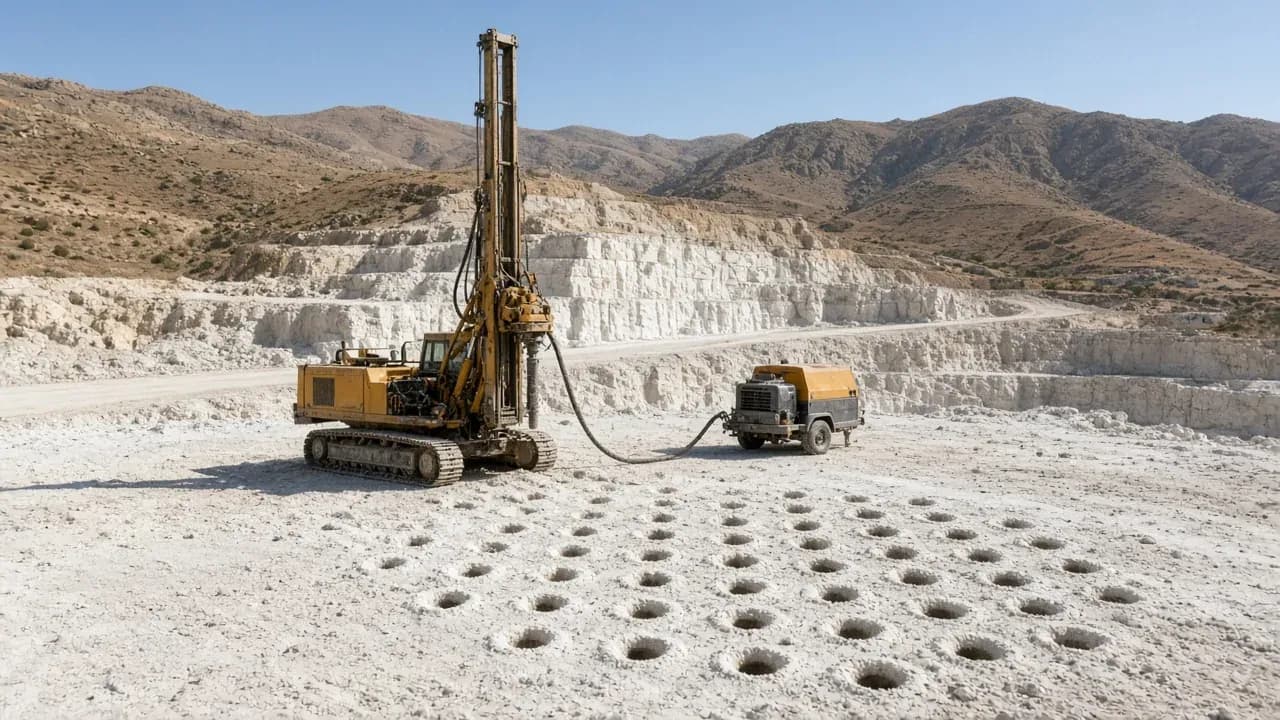
Gypsum Extraction in Open-Pit Mines: From Drilling to Blasting
How is gypsum extracted in an open-pit mine? From drilling with a wagon drill and loading the blast holes to controlled explosions and blasting safety, read the journey of gypsum from the working face to the plant in plain language.
Short answer: Gypsum extraction in an open-pit mine begins with drilling. A wagon drill powered by compressed air from a compressor drills holes into the mine bench. Most of each hole is filled with explosives, the remainder is tamped with damp gypsum cuttings, and the holes are connected into a single circuit. The blast is carried out only by a qualified blaster, in accordance with the approved mine plan.
This article is part of the "Technical, Standards and Specifications" cluster; for the full picture, read Gypsum Setting Time.
Every bag of gypsum, before it reaches the plant, was once a piece of a white bench inside a mountain. In this article, we explain the steps of separating gypsum from the mine in plain language, based on the field experience of the Gach Semnan Sahar team. This text is for general familiarization, not an operating procedure. To learn about the region itself and its production history, read the article Gypsum Mines of Semnan.
What Does Gypsum Extraction Mean?
Gypsum extraction means separating raw gypsum (hydrated calcium sulfate) from the mass in the mine and crushing it into pieces that can be loaded and taken to the plant. In Iran, gypsum is mostly extracted by the open-pit method, and the work usually proceeds in benches; that is, the mine is worked downward bench by bench, and each bench has a "working face."
Gypsum is too hard to be dug out with just a shovel and loader. That is why in most gypsum mines two operations are carried out in sequence: drilling and blasting.
Step One: Drilling the Holes with a Wagon Drill
Drilling is done with an air compressor and a wagon drill. The compressor produces compressed air, and the wagon drill advances the hole into the rock with a bit. The diameter and depth of the holes are not the same in every mine.
What Determines the Hole Diameter?
The hole diameter depends on the power of the compressor and the wagon drill. A more powerful machine can drill a wider hole.
What Determines the Hole Depth?
Depth depends on the conditions of that particular mine. Three questions are decisive here:
For example, suppose each hole is designed with a diameter of 70 mm and a depth of 3 meters. The operator drills exactly these 3 meters with the bit and wagon drill and arranges the holes in a regular grid on the bench.
Step Two: Loading — What Goes into the Hole?
The amount of material placed in the holes depends on the hardness of the gypsum. In gypsum mines, roughly two-thirds of each hole is usually filled with material. This material has three components:
The type of material, its quantity, and the loading method for each hole are determined by the approved blasting plan of the mine, not by individual preference.
Step Three: What Does a "Loaded and Leveled" Hole Mean?
The upper third of the hole is still empty. This section is filled with gypsum cuttings left over from previous blasts; cuttings that have already been slightly dampened. These cuttings are tamped with a long wooden tool until the hole mouth is level with the ground.
Now only a pair of wires connected to the electric detonator protrudes from the mouth of each hole. In miners' terminology, the hole is "loaded and leveled": loaded, because the charge and detonator are in place; leveled, because its mouth is flush with the ground.
Step Four: Connecting the Holes and the Controlled Blast
The next question is how the holes are connected to each other. Suppose that in the blast area we have drilled 20 holes along the length and 10 holes across the width, that is, 200 holes in total. The detonator wires of these 200 holes are connected in series (not in parallel). At the end of the working face, two wires remain. When electric current is passed through these two wires, the detonators activate and the blast takes place.
Safety in Gypsum Mine Blasting
Before the blast, a safe distance from the explosives and from the blast site must be strictly observed. This is done in coordination with the driller, and all personnel at the mine move to a shelter in the direction opposite the blast and stay there.
The safety regulations for mines also set out several clear rules:
In plain terms, working with explosives is the job of trained and licensed people, and no part of it should be attempted without qualification.
After the Blast: From the Working Face to the Gypsum Bag
The blast turns the gypsum into pieces that are loaded with a loader and transported to the plant. The size of these pieces matters, because they must fit into the mouth of the crusher.
At the plant, the gypsum is crushed, calcined, ground, and graded. This same rock, without calcination and only with proper grading, is offered as raw agricultural gypsum. The calcination path also determines which product family the final product belongs to; we have explained this in the article Difference Between Alpha and Beta Gypsum. You can also read about the effect of particle size on gypsum behavior on site in the article Gypsum Grading.
Gach Semnan Sahar Plant has been converting the gypsum of this region into construction gypsum in Momenabad, Semnan since 1984. The final product, from buying base coat gypsum to buying top coat gypsum, is the same rock that once lay in the working face of the mine. To compare these products, see the guide Types of Semnan Gypsum.
Related Articles on This Topic
To purchase or request a quote, see Today's Semnan Gypsum Price.
FAQ
How is gypsum extracted?
In an open-pit mine, holes are first drilled with a wagon drill and compressor, then the holes are loaded and covered with damp gypsum cuttings, connected together, and a qualified blaster carries out the blast. The crushed rock is loaded and taken to the plant.
What role does ANFO play in a gypsum mine?
ANFO is the main, bulk charge of the hole and fills most of its space. Because it has low sensitivity, the emulite or dynamite alongside the electric detonator initiates the blast.
What does a "loaded and leveled" hole mean?
It means the charge and detonator have been placed in the hole and its upper third has been tamped with damp gypsum cuttings so that the mouth is flush with the ground and only a pair of wires remains outside.
Who is allowed to carry out blasting at a mine?
According to the safety regulations for mines, only a blaster appointed by the mine supervisor, working according to the plan approved by the technical officer and under the supervision of the safety officer.
What are the depth and diameter of a hole in a gypsum mine?
There is no fixed number. The diameter depends on the power of the compressor and wagon drill, and the depth depends on the height of the working face and the extraction volume. For example, a hole with a diameter of 70 mm and a depth of 3 meters.