What is the Difference Between Alpha and Beta Gypsum? (Production Process, Not Just Particle Size)
Alpha and beta are both forms of calcium sulfate hemihydrate (CaSO₄·½H₂O); their chemical formula is identical, but their production method and resulting crystal habit, specific surface area, mortar water demand, and hardened gypsum strength differ. Alpha is typically produced in an autoclave (hydro...
Short Answer: Alpha and beta are both forms of calcium sulfate hemihydrate (CaSO₄·½H₂O); they share the same chemical formula, but their production method—and consequently their crystal habit, specific surface area, mortar water demand, and the strength of the hardened gypsum—differ significantly. Alpha is typically manufactured in an autoclave (hydrothermal/pressurized steam conditions), whereas beta is produced via dry calcination in a kettle or rotary kiln under atmospheric pressure. Do not confuse this distinction with "finer particles"; particle size distribution is a completely separate matter.
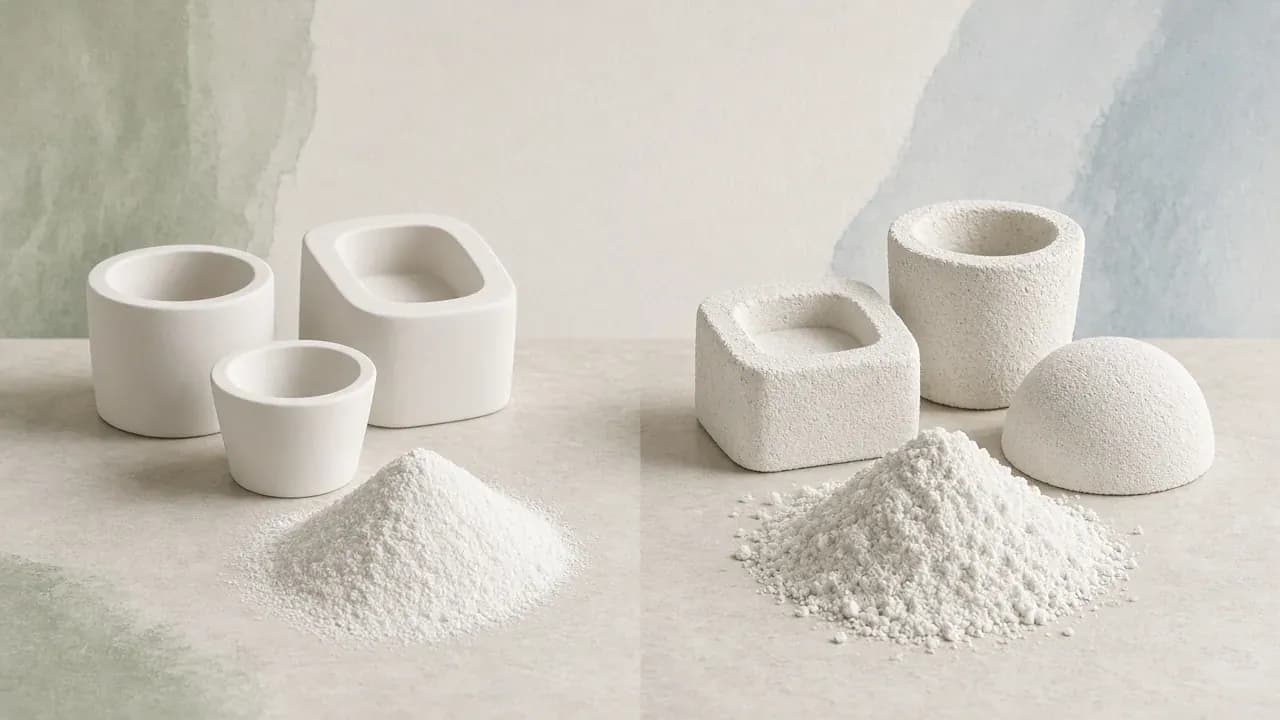
Educational image generated; microscopic structure has not been directly measured.
If you are considering applications for molds and precision components, please visit the Industrial Molding Plaster product page as a related industrial option—not as a claim that "this product is 100% alpha" (such a claim can only be verified through valid manufacturer laboratory analysis). To understand the effect of particle size distribution on construction plaster behavior, read our dedicated article on The Impact of Gypsum Particle Size on Construction Quality: From Adhesion to Strength and Setting Time.
Where Do Alpha and Beta Come From?
The German Gypsum Industry Association (Bundesverband der Gipsindustrie) explains that the α and β crystal forms of hemihydrate have identical chemical compositions yet exhibit different physical properties: α-hemihydrate is produced in an autoclave under pressure at approximately 100°C to 150°C and is utilized for molding plasters and specialized high-strength applications; β-hemihydrate is primarily obtained through dry calcination in large kettles and rotary kilns at roughly 120°C to 180°C (<a href="https://www.gips.de/wissen/rohstoffe/gips-und-anhydritphasen" rel="nofollow noopener noreferrer" target="_blank">Gips- und Anhydritphasen</a>).
Research literature also notes that the α-form is produced under high-pressure hydrothermal conditions, while the β-form is created via dry calcination. Although direct differentiation using X-ray diffraction is often challenging, distinct differences in density, thermal behavior, and water demand have been documented (<a href="https://pmc.ncbi.nlm.nih.gov/articles/PMC6510200/" rel="nofollow noopener noreferrer" target="_blank">Acta Crystallographica / PMC6510200</a>).
Why Does This Difference Matter to the Consumer?
A summary of practical implications repeatedly highlighted by industry sources and technical reviews:
| Topic | Typical Tendency of β (Dry Calcination) | Typical Tendency of α (Autoclave) | ||
|---|---|---|---|---|
| Cost and Production Scale | More common and economical for bulk construction plaster | More expensive and limited in scale | ||
| Mortar Water Demand | Generally higher (greater specific surface area and porosity) | Generally lower | ||
| Hardened Component Strength | Suitable for surface coatings and gypsum boards/walls | Suitable for precision molds and higher mechanical strength | ||
| Typical Application | Skim coating, drywall/plasterboard, general utility | Industrial molding, dentistry, sensitive decorative components |
This table represents general "trends" rather than the exact specifications of a single bag. Industrial α–β blends and additives are common in the market.
Common Misconception: Alpha/Beta = Particle Size?
No. Particle size distribution (mesh) relates to the particle size range after milling and affects trowel feel, surface smoothness, and sometimes reaction speed. Alpha and beta refer to the calcination pathway and the crystal habit of the hemihydrate. Two products may share an identical particle size distribution while one is α-rich and the other is β—or vice versa. Keep Sahr's particle size article separate to avoid content cannibalization.
Connection to Sahr Products (With Scientific Caution)
How to Determine If a Product Is Closer to Alpha or Beta?
Definitive identification is impossible without a laboratory, but practical questions for the supplier can help:
If the answers are vague, do not purchase solely based on a marketing label reading "Alpha".
Relationship with Particle Size and Setting Time (Without Conflating Topics)
Finer particle distribution can yield a smoother surface finish, but it does not replace the definition of α/β. Setting time is also adjusted using additives and does not inherently prove an alpha or beta designation. For particle size, refer to Sahr's dedicated particle size article; for working time, see Plaster Setting Time. This separation ensures each page serves a specific search intent.
When Should You Choose the Molding Product Family?
If your goal is mold-making, producing detailed decorative pieces sensitive to fine features, or industrial applications requiring higher strength than standard skim coating, the Industrial Molding Plaster product path and technical inquiry are the logical choices. If your objective is general wall skimming, a β/construction grade and surface or micronized products will usually suffice—and you can check current pricing at Semnan Plaster Price Today.
Related Articles on This Topic
For purchases or inquiries, check out the Daily Price of Semnan Plaster.
References
FAQ
Is alpha always better than beta?
No. For broad wall covering, β is more economical and common; alpha is valued for strength and molding precision.
Can simple XRD differentiate between α and β?
Research sources indicate that distinguishing them with standard XRD is difficult, requiring reliance on density, thermal analysis, and mortar behavior.
Is Semnan construction plaster alpha or beta?
It cannot be labeled definitively without product analysis; industrially, most bulk construction plasters follow the β pathway.
Which page should I check for molding applications?
Industrial Molding Plaster, along with technical inquiries from sales if necessary.